


Multifunction Ergonomic Chair
Unlike a standard office chair, where typically there are no armrests (or armrests in an uncomfortable position), no lumbar support and no movement, ergonomic chairs are designed to support the human body in the best way they can. Ergonomic chairs take into consideration posture, comfort and health and are made to support the natural shape of the spine to prevent slouching and help reduce stress on the body.
Description
Company Profile
Company predecessor was an office furniture parts manufacture which founded in 2002 and in 2010, Anji Herui Furniture Co., Ltd has founed. After over ten years development, we have more than 160 employees, own two production facilities with 18,000 square meters.
Why Choose Us?
Technical support
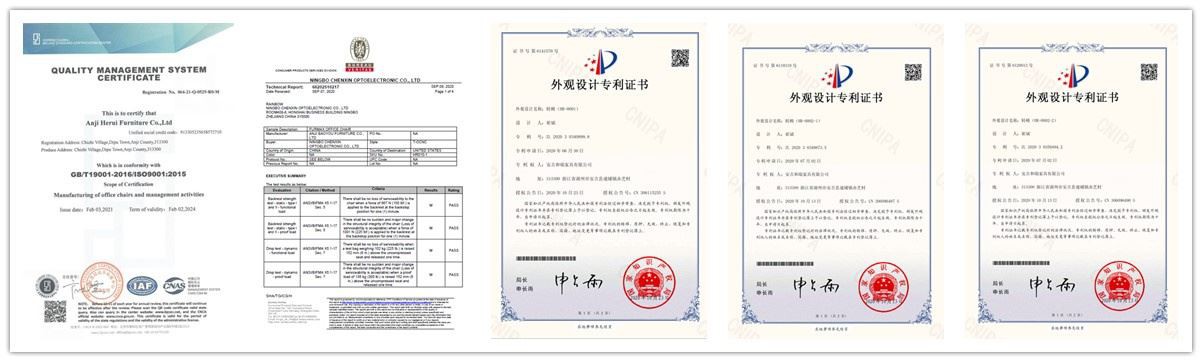
We own more than 10 patents, also have obtained certificate such us BSCI, ISO9001; also have appearance patent of some items.
High quality
We established rounded product manage system, strict quality control system, as result we could provide high quality products and good on-time-delivery.
Quality control
We own injection molding workshop by ourself that makes the quality and cost could be in good control.
Production capacity
Our company has capacity reaches 160, 000pcs per month and annual yield 20million dollars.
Related Product

This Ergonomic swivel mesh chair uses a breathable mesh material that fits any body type without accumulating heat.

Comfortable Ergonomic Mesh Office Chair
The Comfortable ergonomic office chair allows you to feel cool in summer. The seat is composed of wood, sponge and mesh.

This mesh chair used on office, have a cozy backrest, the seat with breathable mesh combine with foam, make you a good seat feeling.

White Frame Mesh Ergonomic Chair
The mesh chair with white frame and white painted base, foldable armrest makes the worksapace more flexible, can push under the desk.

Comfortable Mesh Ergonomic Chair
Our factory Anji Herui Furniture Co., Ltd is a professional manufacture of mesh chair, gamingchair and bar stool, specialized in mesh chair.

Adjustable Armrest Ergonomic Office Chair
This mesh chair, have an adjustable armrest, this can make the space more flexible, when the armrest up, you can push the chair under your desk .

Adjustable Armrest Ergonomic Chair
As we factory Anji Herui Furniture Factory is a professional manufacture of mesh chair, gamingchair and bar stool, specialized in mesh chair.

Multifunctional Ergonomic Office Chair
About the item: Multifunctional ergonomic office chair. Optimal height allows your feet to rest firmly on the floor, creating a 90degree angle with your knees, ankles and hips.

High quality lumbar support chair makes your work more comfortable,the cover is made of mesh which gives you a breathable feeling.
What is Multifunction Ergonomic Chair?
Unlike a standard office chair, where typically there are no armrests (or armrests in an uncomfortable position), no lumbar support and no movement, ergonomic chairs are designed to support the human body in the best way they can. Ergonomic chairs take into consideration posture, comfort and health and are made to support the natural shape of the spine to prevent slouching and help reduce stress on the body.
Benefits of Multifunction Ergonomic Chair
Posture Support
Traditional chairs can put undue strain your spine, and over time can lead to bad posture whilst increasing your susceptibility to back injuries. Ergonomic chairs are fully adjustable to align with your height and workstation, ensuring you remain in the correct sitting posture.
Helps with Back Pain
Lower back pain is one of the leading causes of absence from work in Australia. Ergonomic chairs feature a backrest that has been designed to support the natural curvature of your spine. The backrest is also taller to provide support for the entire back.
Reduces Neck Pain
Office workers often complain of stiffness in the neck and shoulder region. This can lead to complications like spondylosis – a loss of cartilage lining in one's vertebrae. Ergonomic chairs may include a headrest to provide support for the head and neck too.
Improved Blood Circulation
Another major benefit of ergonomic chairs is the positive effect they have on blood flow. Adjusting your seat to a 90-degree angle allows proper circulation in the legs. Good circulation prevents your legs from swelling or going numb.
Relieves Hip Pressure
A hard chair can put unnecessary pressure on your hips. Ergonomic chairs have sufficient padding and depth to help support the hips and reduce this stress and pressure.
Boosts Productivity
Comfortable and supportive chairs lead to happy and healthy employees or students, who are less likely to be distracted or suffer from aches and pains which may force absences. As a result, the introduction of ergonomic chairs have seen reported increases in productivity and work quality.
Types of Multifunction Ergonomic Chair
Kneeling ergonomic chair
This chair uses a modified kneeling position for sitting. In this chair, there is no back. It has a forward-slanting seat that leads to a more natural position for the spine
One sits by sliding the hips forward and aligning the back, shoulders, and neck.
The legs are bent at the knee and placed at the shin support below.
The idea is to distribute the weight between the pelvis and the knees. Therefore it could be useful for back pain and conditions which require a decrease of spinal loading.
Saddle ergonomic chair
A saddle chair is in the shape of a horse's saddle. Its base is on casters so that moving around is easy and height can be easily adjusted using a lever.
Some saddle chairs have backrests, but most do not.
The position on this chair is somewhere between sitting and standing.
This chair allows legs to drop and widen which creates a stable posture.
With long term use, it can even strengthen the back muscles.
The idea behind this design is to eliminate some of the issues experienced with a traditional chair such as circulation system problems and slouching forward.
Exercise ball ergonomic chair
This chair is to encourage movement and active sitting and can be used as a desk chair or computer chair.
The chair consists of a sturdy ball. There is an option of putting on a stable base and backrest.
The slight bouncing movement due to the shape of the chair stimulates the circulation and keeps muscle slightly working.
Thus fatigue and stress are reduced.
Slouching is difficult and posture is improved.
Recliner chair
This could be the most relaxing chair for the back and most comfortable. It could be modified to carry out different works in a reclined position. Like small tables can be attached for paperwork or laptop use.
Components of Multifunction Ergonomic Chair
Chair back
Lumbar support is one of the most important aspects of an office chair. The chair must be able to adjust to provide good support to your lower back. Most people prefer the chair back to be at a 90-110 degree angle to the seat for a comfortable position. The height of the chair back is also important so that the shoulders have adequate support.
The choice of materials means you can choose a chair back to suit you. Some people like a solid chair back while mesh backs are popular amongst those who feel the heat while working.
Chair height
Being able to change the height of the chair is the most basic chair change and a good place to start. The correct posture while sitting at a desk and using a computer is to have your feet flat on the floor or a footstool with the arms in line with the desk height.
Chair arms
Some people don't like chairs with arms while for others they're a must have. A chair with arms can reduce the strain on your neck and shoulders and stop you from sitting forward in the chair.
Make sure the arms can be adjusted so the chair can fit under the desk and you can sit close enough to work comfortably. Your forearms should be at a 90-degree angle to the upper arms.
Leather
Leather is the most common and, in fact, the most used material in an ergonomic chair. Although, with the current sustainable living practices, most people are now avoiding anything made from leather.
Leather gives an ideal and luxurious look to the ergonomic chair; in fact, the feel is all executive. We often find leather-made ergonomic chairs in offices; however, now some people might prefer them for home as well if they work from home.
Fabric
It is the most common type of material used in an ergonomic chair. It is more durable and comfortable than most of the ergonomic chair material; in fact, it comes in at very reasonable prices as well.
The fabric ergonomic chairs are naturally breathable, and air passes through them, keeping the user cool. Fabric is the most popular choice in everyday use, likewise in ergonomic chairs. If you are looking for a normal ergonomic chair, then go for the one made from fabric material.
Mesh
Mesh made from fabric is another most common type of material used in ergonomic chairs to add extra layers of comfort to the users. In fact, mesh chairs are ideal for warmer offices, people who sweat a lot, or those working in hot climates.
The net-like material enables better circulation throughout the day. The seat of the ergonomic chair will consist of a top layer of mesh that will allow more breathability and through the bottom of the chair.
Plastic
Certain parts of ergonomic chairs, such as the frame and armrests, may be made of high-quality plastic. This material is lightweight, durable, and easy to mold into ergonomic shapes.
Metal
Metal frames are often used for the base and support structure of ergonomic chairs. Aluminum or steel are commonly used due to their strength and stability.
Modern ergonomic chairs maintenance is designed to be simple. Set and forget, never to be revisited… until it breaks. Office chairs get bumped, tipped, scratched and just used year after year and it all adds up.
The good news? These are simple machines so the regular maintenance is simple as well. You might be wondering what to oil and where to crack it open, but the secret sauce is cleaning. Keep the adjustable levers, flanges that hold the wheels and floor underneath your chair dust free and clean, and the chair will last years longer.
If the chair is already old, and especially if you are the second owner, do a 360 check. Look at all the surfaces, materials, nooks and crannies, and then test each of the levers. Flag anything that looks loose or cracked, and replace the part or if necessary the whole chair.
What Are the Features of a Good Chair?
Some features are important for a good chair regardless of how you intend to use it:
Adjustability - Check to see that seat height is adjustable.
Seat height range - Check whether the seat height can be adjusted to the height recommended for the worker(s) who will use it. Alternate chairs may have to be selected for very short or tall workers. Ideally, a user should be able to sit with their feet on the floor or on a footrest without pressure on the underside of their thighs.
Backrest - Check to see that the backrest is adjustable both vertically and in the frontward and backward direction and has a firm lumbar support, but does not create pressure points that restrict blood circulation. The backrest should be of appropriate height and width to provide support without restricting movement.
Seat depth - Select the seats that suit the tallest and the shortest users. Users should be able to sit in the chair without pressure at the back of their knees, with their back supported by the backrest, and support through the buttocks and thighs.
Seat width – The seat should be wide enough to allow users to have a comfortable and even pressure across the entire seat, and allow for some adjustments to their posture.
Seat angle – Where the angle of the seat is adjustable, the seat should allow users to support their feet on the floor or footrest. Forward sloping seats should have a surface that has enough friction to prevent the user from sliding out of the chair or placing too much weight on their feet.
Seat surface – The seat surface should be comfortable, usually made of breathable materials that minimize heat and moisture buildup. In some workplaces, such as healthcare or laboratories where infection control is a concern, other materials may be more appropriate.
Armrests – Armrests should provide support and evenly support the arms. The rests should be adjustable both for height and width (distance from the seat). In other situations, armrests may not be helpful if they prevent a person from sitting close enough to the desk and keyboard. Adjust or remove armrests, as needed.
Stability - Check for the stability of the chair; a five-point base is recommended.
● Other features to consider
See if the selected chair has features that will help someone do their job better. Arm rests with adjustable heights are good for computer operators. Wider or narrower arm rests may also be required depending on the worker's dimensions and tasks they do.
See if the selected chair has features that will make doing a job more difficult. An example may be that someone may be using a chair with casters or wheels when a stable and stationary work position would be better. If chairs with casters are needed, choose ones that match the type of flooring you have (e.g., hard casters for carpeting or soft casters for hard floors). Determine if there is a need to have brakes on the casters.
The user should be able to operate the controls from a seated position where practical, and be logical in their placement and function.
How to Properly Set Up Office Chair
If you have an ergonomic office chair, and you are experiencing discomfort, you may not be using your chair correctly. In order to reap the benefits of an ergonomic office chair, you're going to have to know how to sit in it, and adjust it properly.
Where to set seat height
To adjust your office chair to fit you, start by changing your seat height. Your feet should be flat on the ground with your legs bent at a 90-degree angle. If your chair is unable to adjust low enough, we suggest using a footrest.
Adjusting seat depth
If your chair has an adjustable seat pan, you will also want to adjust this correctly. With your back flat against the backrest, make sure to adjust the seat so that there is at least one inch between the edge of the seat and the back of your knees.
Backrest
Most chairs will have varying backrest adjustments. If your chair has backrest height, move the back so that the lumbar area fits into your lower back. Adjust the backrest tension so that it provides support, which also allows you to move freely.
Where to position lumbar support
Some chairs have built-in lumbar, while others allow you to adjust it. The lumbar support should sit at your lower back. If your chair has lumbar depth, adjust accordingly to your liking.
Adjustable armrests
Your armrests should always be at the same height. They should sit at about elbow height when your arms are vertically against your sides. If your armrests have width or can pivot, move these until they fit you comfortably.
How to position headrest
For chairs with a headrest, adjust the headrest to the base of the back of your head. Your head should not feel like it's being pushed forward or downward.
Having an Ergonomic Chair Doesn't Equal Good Ergonomics
Good ergonomics will help reduce injuries, keep you fresh and comfortable. But this is only possible if the tool, in this case an ergonomic chair, is used correctly.
If you try to strike a nail with the handle of your hammer, you won't drive it in. Similarly, if you passively sit in an ergonomic office chair, unadjusted, off-centre, making awkward movements reaching for your keyboard or printer, you won't see the potential benefits.
Think of the features of your ergonomic office chair as prompts. Each adjustment should be made to your body to achieve the proper fit. For example lean into the back and set the right resistance for your weight, then keep leaning back slightly all day long. The backrest really is designed to carry some of your weight. Armrest lateral adjustments, lumbar tension, all of these things are designed for you to set, and then keep using all day long.
And one critical tip is that movement is not only ok, it is recommended. If you find yourself leaning, crossing your legs, slouching forward then get up! Go get a drink of water, move around, take a short break even. Then sit back down with intention, use some small but deliberate tension on each touch point with your chair. Remember: "motion is lotion, movement is medicine."
The Future of Ergonomic Office Chairs Following Innovations and Trends
As we stand on the precipice of a new era in office furniture design, the future of ergonomic office chairs unveils a landscape of innovation and evolving trends. The symbiotic relationship between technology, user-centric design, and a commitment to well-being paves the way for transformative advancements.
Smart ergonomics
The integration of smart technology into ergonomic chairs is poised to revolutionize the workplace. Smart chairs may feature sensors that monitor user posture, sending real-time feedback and encouraging healthier sitting habits.
Sustainable materials
The future of ergonomic chairs aligns with sustainable practices, with a focus on eco-friendly materials and manufacturing processes. Chairs crafted from recycled materials and designed for easy disassembly for recycling or refurbishment contribute to a greener future.
Adaptive seating
The concept of adaptive seating envisions chairs that dynamically respond to the user's movements. Whether through responsive materials or intuitive adjustments its adaptive seating aiming to enhance user comfort by intuitively adapting to changing postures.
Biophilic design integration
Bringing nature into the workspace is a growing trend. Ergonomic chairs may incorporate elements of biophilic design, integrating natural materials, textures, or even living plants to create a more calming and harmonious work environment.
Personalized wellness
Future ergonomic chairs may delve deeper into personalized wellness features. This could include options for temperature control, personalized lumbar support algorithms, or even adaptive seating surfaces that conform to individual preferences.
Collaboration-focused designs
With the evolving nature of work environments, ergonomic chairs are likely to embrace designs that facilitate collaboration. This may involve modular seating arrangements or chairs with integrated technology to support group activities.
Our Factory
ANJI HERUI FURNITURE CO.; LTD. was founded in 2010 and located in Anji city Zhejiang Province China. We are a professional manufacture of office chair specialized in mesh chair. Capacity reaches 160, 000pcs per month and annual yield 20million dollars.


Certificate
FAQ
Hot Tags: multifunction ergonomic chair, China multifunction ergonomic chair manufacturers, factory, desk & chair set, Adjustable Armrest Ergonomic Chair


