How to Install a Foot Rail on a Bar Stool Properly?
Apr 15, 2025

As a common seat in homes and shops, bar stools not only pursue beautiful appearance, but also emphasize comfort. In order to alleviate the discomfort caused by sitting for long periods of time, many users choose to add foot bars to bar stools to improve the overall use experience. Therefore, this article will explain in detail: why office chairs need foot bars, how to choose a suitable model, how to install it safely and correctly, precautions after installation, etc.
Why bar stool need to install a foot lever?
When sitting for a long time, if the feet cannot touch the ground, the weight of the entire lower limbs will be pressed on the edge of the chair surface through the back of the thighs, which will cause continuous pressure on the biceps femoris area behind the thighs and the blood vessels behind the knees. Especially the popliteal artery, popliteal vein and sciatic nerve branches, long-term compression will seriously affect the blood circulation of the legs. As a result, the user may start to feel numbness in the calves, tingling in the soles of the feet, coldness and even swelling in the insteps after one or two hours of work.
Secondly, from the perspective of sitting structural mechanics, the human body mainly receives force through three points when sitting: the ischium support point, the foot support point, and the backrest support point. Once the foot support point disappears, the body's natural instinct will be to find a new balance fulcrum by leaning forward, crossing the feet, crossing the legs, etc. Most of these compensatory postures will cause the pelvis to tilt backward, the lumbar spine to straighten or bend, and the shoulders and neck to protrude forward, and other undesirable postures.
After installing the foot bar, the feet can receive stable support and the "three-point force bearing" structure in the sitting posture is restored, that is, the ischium, feet and back are stressed at the same time, so that the body no longer needs to lean forward to compensate for balance; at the same time, the weight of the lower limbs no longer concentrates on the edge of the thigh, but is partially transferred to the step circle, thus effectively reducing the pressure on the blood vessels behind the knee.
The foot bar is not a universal accessory. If you want to install it smoothly, you must first confirm whether the structure of the bar stool supports additional installation. Most bar stools on the market adopt a central lifting structure, that is, the seat is connected to the five-star base at the bottom through a pneumatic rod. The pneumatic rod is usually cylindrical and has different diameters such as 50mm and 60mm. The installation method of the foot lever is to connect it to the middle section of the air lever through the middle hole, and then fix it on the outer wall of the air lever with screws or clamping structures.
At this time, you need to pay attention to two points: first, whether the air pressure rod is exposed to a sufficient length for installation (at least an exposed section of 7cm or more is required); second, whether the inner diameter of the foot rod matches the air pressure rod. If the chair has a short chassis or even a standard cylindrical air bar, the foot bar will not fit or be securely attached. Therefore, before purchasing a foot lever, it is best to measure the diameter and exposed height of the air lever and consult the manufacturer to confirm compatibility.
How to choose a suitable foot lever model?
Although there seems to be little difference in the structural styles of the foot levers, there are many differences in details. According to functions and usage habits, they can be divided into three types: fixed, rotatable and liftable:

Fixed foot lever
The simplest structure and cannot be rotated after installation. Therefore, it is very suitable for users who have a bar stool in the same position for a long time and have a relatively fixed sitting posture, such as accountants, clerks, designers, etc. who do not frequently change their sitting postures.

Rotatable foot pole
The pole body can rotate slightly according to the angle of the foot. It is suitable for users who are accustomed to changing sitting postures and frequently moving their feet, such as customer service, marketing, teachers, video editors, etc.

Liftable foot bar
The height can be adjusted with an independent knob to meet the personalized needs of users of different heights and leg lengths. It is especially suitable for use as a chair in shared office spaces or open workstation areas.
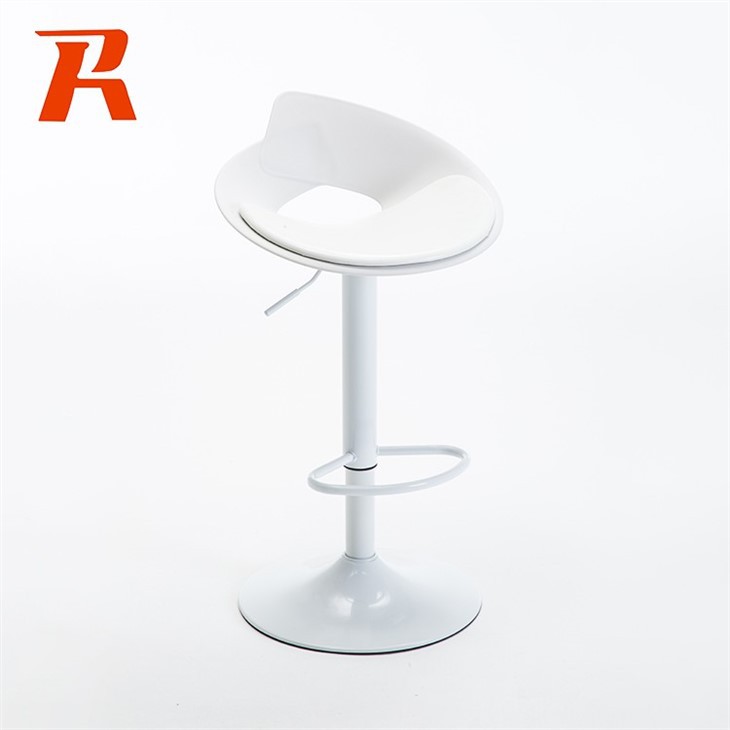
Diameter of the stepping circle
If the diameter is too small, the feet will be suspended in the air; if the diameter is too large, tension will be generated on the legs, which is not conducive to natural hanging. It is recommended to choose a size that matches the distance between your legs when you are sitting. Generally, the outer edge of the chair chassis should be slightly larger than 5 cm.
Detailed explanation of correct installation steps
After confirming the model and compatibility, the next step is the specific installation operation. It is recommended that two people work together to complete the entire process for better fixation and balance:
Remove The Seat Part: Turn the bar stool over, find the connection point between the chassis and the air pressure rod, tap it lightly with a rubber hammer or use a pry bar to loosen it, and pull the seat out of the air rod. Be careful not to use brute force to avoid damaging the bottom buckle.
Pre-installed Foot Lever: Slide the foot lever onto the exposed air lever, usually in the middle or near the bottom. Keep it level when inserting, making sure the step circle is parallel to the ground.
Lock The Step Ring Position: Use a screwdriver or hexagonal wrench to tighten the step rod fixing screw. During the process, pay attention to see whether it fits tightly with the air rod and whether it is slipping or loose.
Restore The Seat Structure: Press the seat back onto the air pressure rod and make sure the buckle is fully inserted without leaving any gaps. You can sit on it and test it again to see if there is any shaking or abnormal noise.
Adjust The Comfort Level: After the installation is complete, sit on the chair and place your feet naturally on the step bars to check whether the soles of the feet can be naturally supported and whether they maintain a natural angle with the thighs. If the foot lever is too high or too low, the installation position needs to be readjusted.